Precision vs. Velocity: The Ultimate Guide to GPT Image 2 and Nano Banana 2
Artificial intelligence in visual design has officially graduated from a novelty to a mission-critical commercial tool. Today, creators, marketers, developers, and product teams are no longer just experimenting with prompts—they are relying on AI to power real-world workflows: high-converting product ads, landing page mockups, brand storytelling, and educational graphics.
In this rapidly maturing landscape, two powerhouse models have emerged as industry favorites: GPT Image 2 and Nano Banana 2.
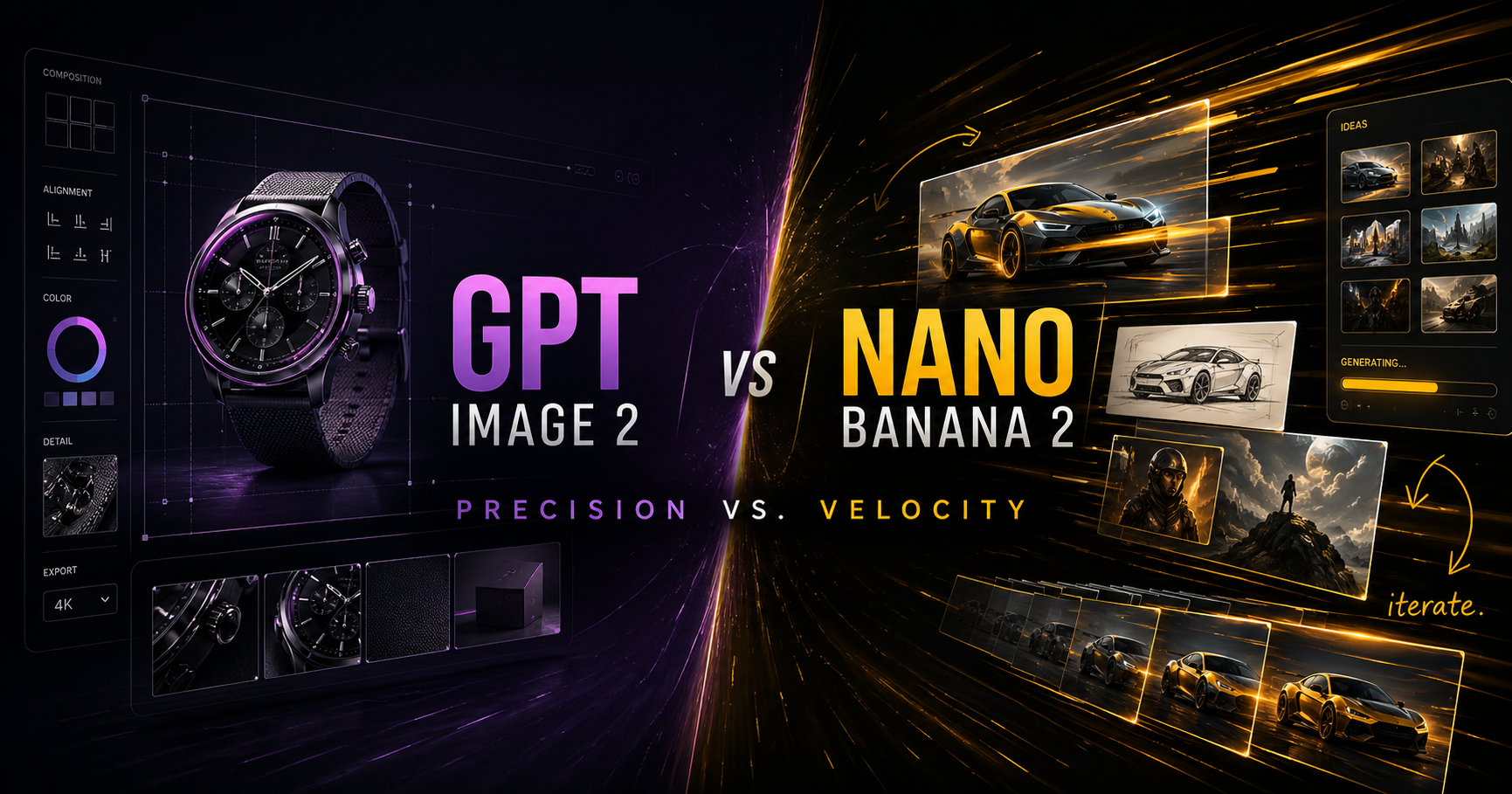
While both are bleeding-edge visual engines, they are engineered with entirely different philosophies. GPT Image 2 is OpenAI’s precision instrument, designed for high-fidelity production, meticulous editing, and flawless text rendering. Conversely, Nano Banana 2 (officially powered by Google’s Gemini 3.1 Flash Image) is built for pure velocity, optimized for low latency, high-volume ideation, and conversational iteration.
For professionals who want the best of both worlds without the hassle of managing multiple API keys, platforms like GPT Image 2 have become the go-to solution, offering centralized access to a suite of top-tier AI models.
Here is a deep dive into how these two heavyweights stack up, and how to choose the right model for your next creative sprint.
The Contenders
GPT Image 2: The Precision Production Engine
GPT Image 2 represents OpenAI’s state-of-the-art capabilities in visual generation. Built to accept both text and high-fidelity image inputs, it is specifically engineered for strict instruction following and complex spatial layouts.
GPT Image 2 thrives on nuance. If you need to feed a model a highly layered prompt detailing target demographics, lighting setups, emotional tone, precise typography, and product placement, this is your model. It is the definitive choice for tasks that require a polished, production-ready aesthetic right out of the gate, such as commercial advertising, UI/UX mockups, and corporate brand assets.
Nano Banana 2: The Conversational Iteration Machine
Nano Banana 2 is the widely adopted moniker for Google’s Gemini 3.1 Flash Image. Google explicitly positions this model as a high-efficiency, low-latency counterpart to its heavier Pro models.
Nano Banana 2 is built for the "flow state." It excels when creators need to generate a massive volume of concepts quickly, test various visual directions, and refine them conversationally. By seamlessly processing text, images, or a hybrid of both, it allows developers and designers to brainstorm at the speed of thought. While it may not instantly nail a highly restrictive commercial layout on the first try, its rapid iteration cycle makes it an unbeatable tool for concept art and visual prototyping.
Technical Showdown: Input & Output Parameters
Understanding how these models handle inputs and outputs is crucial for developers and SaaS builders aiming to integrate them into their platforms. Below is a breakdown of their practical workflow capabilities.
| Feature / Capability | GPT Image 2 (OpenAI) | Nano Banana 2 (Gemini 3.1 Flash Image) |
|---|---|---|
| Primary Input | Text and Image | Text, Image, or Hybrid |
| Primary Output | Image | Image |
| Generation Strength | Highly controlled, complex text-to-image | High-speed, efficient text-to-image |
| Editing Workflow | Granular, precise image editing & transformation | Fluid, conversational, and iterative editing |
| Prompt Complexity | Thrives on detailed, structured, multi-layered prompts | Optimized for natural, conversational prompting |
| Text Rendering | Exceptional. Ideal for UI, posters, and readable labels | Capable, but secondary to generation speed |
| Sizing & Aspect Ratio | Highly flexible; adaptable API sizing for custom aspect ratios | Supports standard production-ready resolutions |
| Speed vs. Quality | Medium speed; heavily prioritizes fidelity and control | Ultra-low latency; prioritizes rapid generation |
| Ideal Use Case | Production-ready assets, brand design, text-heavy graphics | Rapid ideation, moodboarding, concept exploration |
The 4 Core Differences in Real-World Workflows
1. Production Control vs. Fast Iteration
The fundamental divide between these models is their workflow philosophy.
- Use GPT Image 2 when you know exactly what you want. If a digital marketer needs a minimalist skincare ad featuring a central product, soft studio lighting, legible serif typography, and a 9:16 aspect ratio for an Instagram Reel, GPT Image 2 will execute the brief with surgical precision.
- Use Nano Banana 2 when you are still exploring the map. If an art director needs ten distinct moodboards for a new video game environment in under a minute, Nano Banana 2’s raw speed and conversational tweaking will keep the creative momentum alive.
2. Typography and Graphic Design
For years, the inability of AI to render legible text crippled its usefulness in professional graphic design.
- GPT Image 2 has largely solved the "text problem." It handles complex typography, UI layouts, product labels, and localized text with striking accuracy. If your visual asset requires words to be read by a customer, GPT Image 2 is the undeniable first choice.
- Nano Banana 2 can generate text, but its architecture is geared toward speed rather than pixel-perfect typographical rendering. It is better suited for visual concepts rather than final, text-heavy commercial deliverables.
3. Editing and Reference Image Workflows
Both models allow you to upload reference images, but they treat the editing process differently.
- GPT Image 2 is built for controlled transformations. It allows creators to preserve specific brand elements while seamlessly altering backgrounds or lighting conditions.
- Nano Banana 2 favors a conversational editing loop. You can ask it to "make it moodier," "swap the background to a cyberpunk city," or "try a watercolor style," and it will fire back rapid variations. It feels less like using a software tool and more like chatting with a junior designer.
4. Commercial Application Strategy
For final commercial deployment—where the asset must look expensive, on-brand, and highly polished—GPT Image 2 holds a distinct advantage. It is the engine you use to print the final poster or launch the global ad campaign.
However, Nano Banana 2 remains an indispensable asset for enterprise teams during the early stages of a project. It is the ultimate brainstorming partner, allowing teams to quickly generate campaign directions before committing to final production.
The Final Verdict
GPT Image 2 and Nano Banana 2 are not mutually exclusive; they are highly complementary.
If your task demands production-ready fidelity, perfect text rendering, and granular commercial control, GPT Image 2 is your champion. If you need to explore a dozen visual concepts in the time it takes to drink a cup of coffee, Nano Banana 2 is your speed demon.
The modern creator's workflow no longer relies on a single, monolithic model. The most successful teams use a multi-model approach: deploying Nano Banana 2 for high-speed ideation, and GPT Image 2 for final asset refinement.
To future-proof your creative pipeline, platforms like GPT Image 2 provide the ultimate flexibility, allowing you to access the right model for the right task, all from a single, unified workspace. In the new era of AI design, versatility is the ultimate competitive advantage.